On the platform, the Channel strategy is implemented in three different variations:
- GRID - creation of an order grid to cover price ranges
- LEVELS - individual work with levels
- SCALE - a symbiosis of Fibo and Channel, with the ability to trade within a channel, use averaging, and place individual levels both within Fibonacci and beyond its boundaries
Each type covers specific tasks and goals for working with assets.
GRID
Range management using an order grid
Designed to work with price ranges in sideways market conditions.
It allows efficient use of strategies based on creating order grids, both before a range is formed (waiting for the asset to enter a potential accumulation zone) and in real time, with the ability to enter at market price and then place a grid of sell orders.
Use cases of the GRID system:
Working with the Channel strategy using the GRID scheme:
Trading in ranges and accumulation zones
GRID is ideal for working within predefined price ranges. If the task is to set up trading inside a specific range, the system allows you to set boundaries, launch the strategy, and automatically place orders within the range. When orders are executed, you can enable automatic restart or one-time execution.
“Ping-pong” strategy for trading price drops
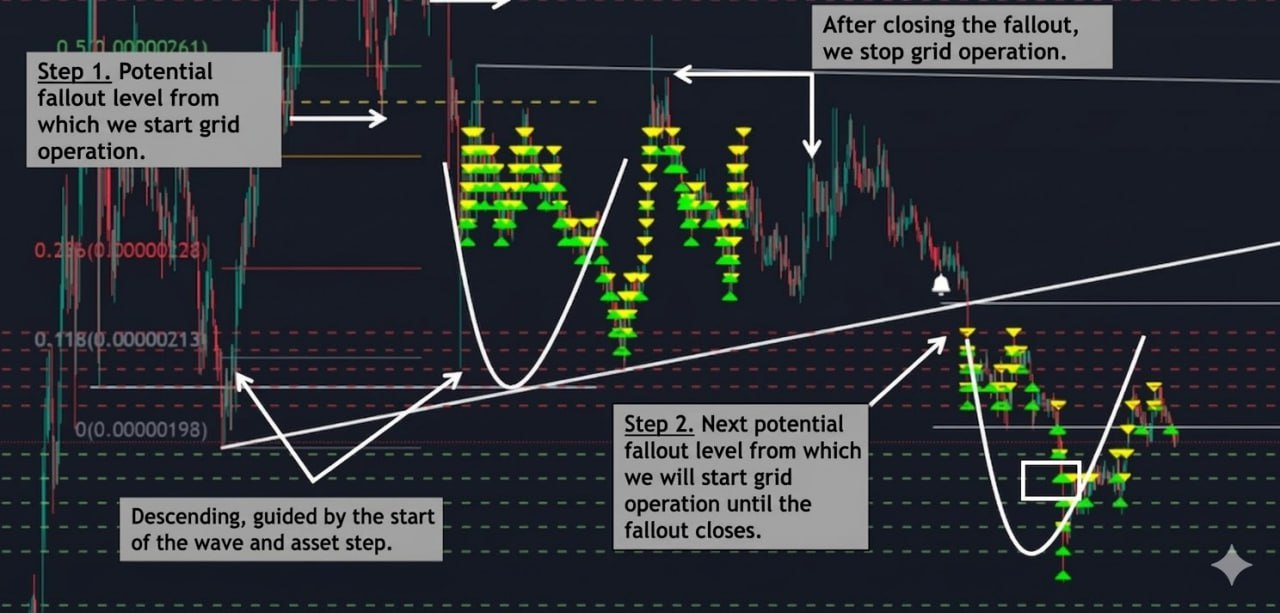
This approach involves processing price drops of up to 50 percent downward or in steps of about 10 points. On the chart, assets are identified that return back after falling below a certain level, which allows trading the closure of such drops. The order grid is distributed across levels and restarted when necessary.
Defining a level and distributing the order grid
On the chart, an asset is selected for which the order grid should be distributed using the Channel strategy. The level is determined based on the current price and chart history. In the example, the first grid of orders has a step of 3 points, covering the initial wave, while the second grid also has a step of 3 points, covering the beginning of the previous growth wave.
Launching the strategy and monitoring
The Channel strategy is launched, and using projections on the chart, the required range for the grid is selected. The steps between limit orders are configured, and automatic order restart is enabled if necessary.
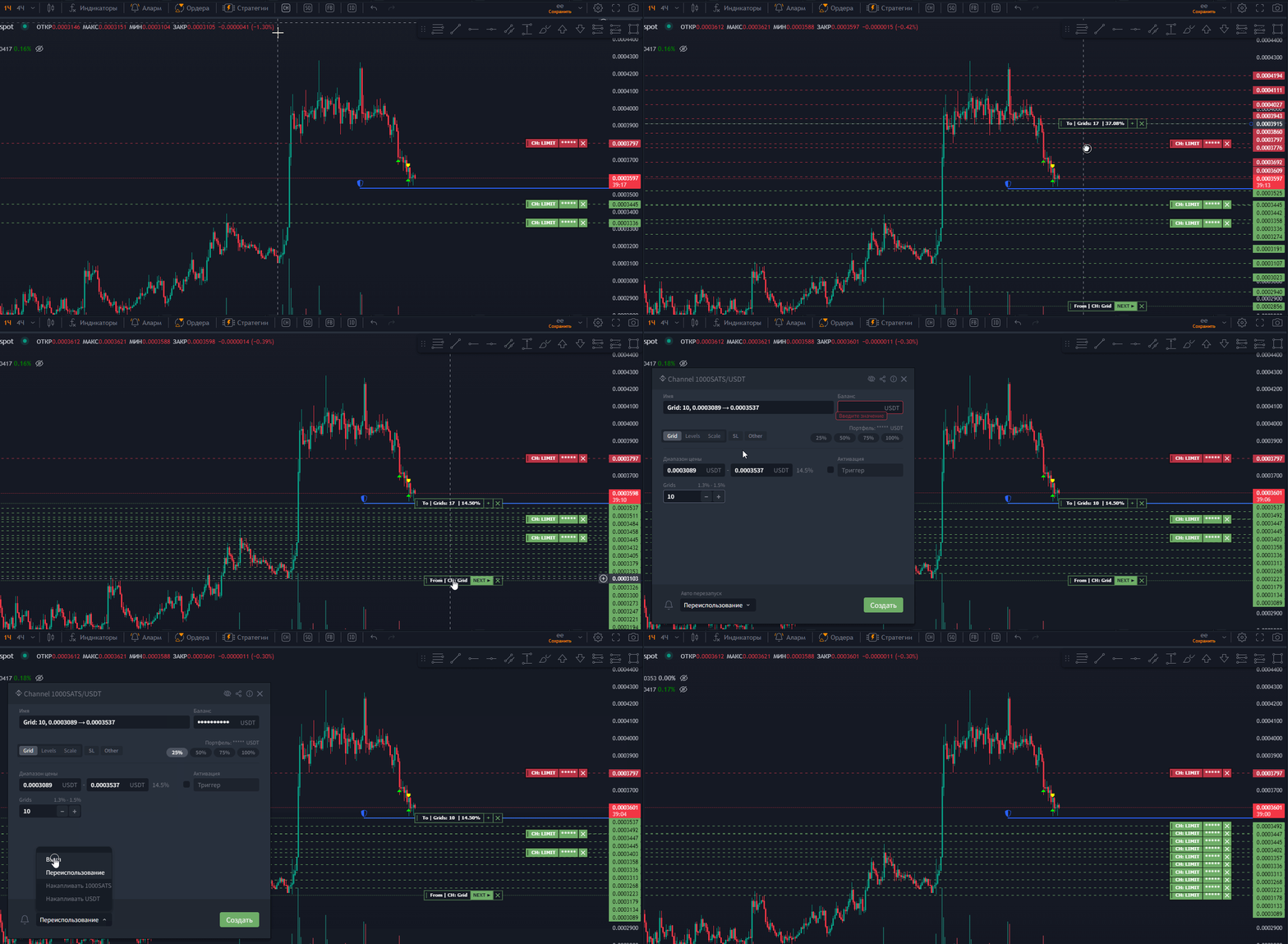
3. Waiting for the drop to be completed. After that, rebuilding the grid if required.
GRID provides extensive capabilities for working with various ranges.
2. Working with ranges and accumulation zones
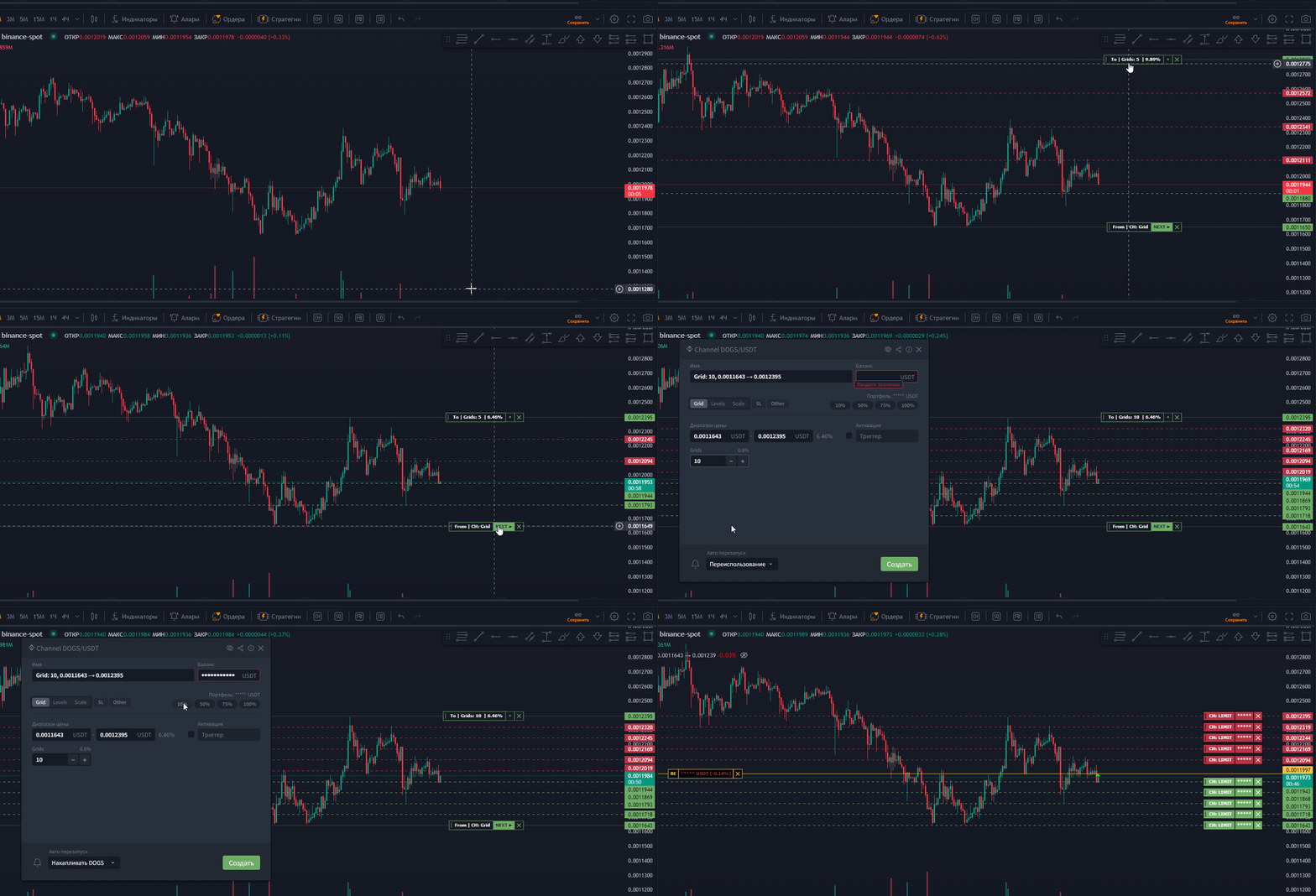
The GRID can be used to work within an already formed range. If your task is to configure grid operation within a given range taking into account the current price, select the boundaries and launch it as shown in the example in the video below.
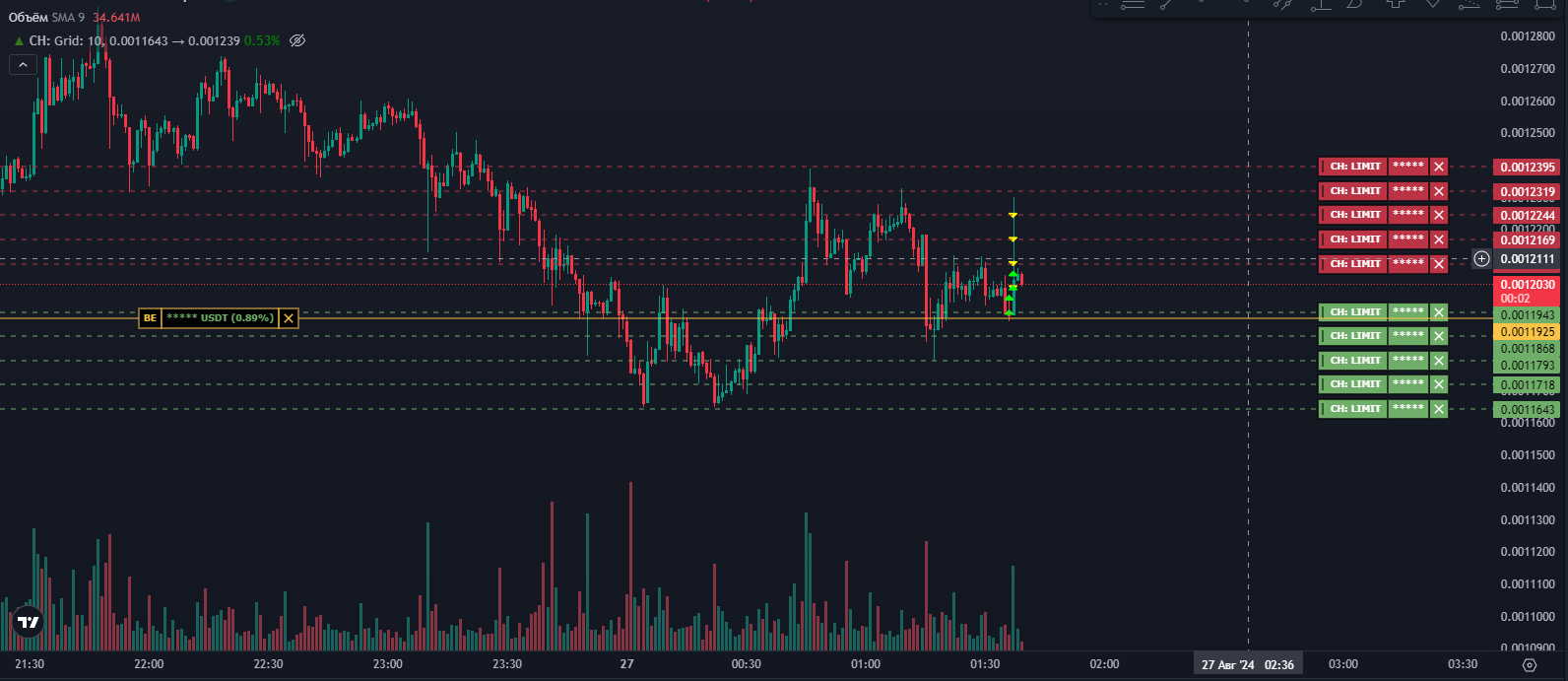
After the strategy starts, some limit orders that were displayed as projections above the price will be executed at market. At the same time, sell orders will be placed immediately, and if the restart option is enabled, the strategy will continue operating within the range until the stop point predefined by you.
 ⇩
⇩ 
LEVELS
Individual work with levels
Designed for precise configuration of work with levels and zones of interest. Focused on intraday trading and offers flexibility in setting single channels or small grids to manage trades during the day.
Key features of LEVELS:
Trade automation
Supports an automated algorithm for pending buy and sell orders with the ability to set a stop loss or use a small order grid to protect the position.
Flexible order configuration
Allows combining multiple orders and manually adjusting them to selected levels. You can distribute orders evenly or use weighting to increase position size at specific levels.
Averaging function
The ability to work in an averaging mode similar to the Fibonacci approach, where new sells or buys are shifted to a lower or higher level to minimize losses and increase strategy efficiency.
Application of the LEVELS system
Suitable for semi-automatic trading if:
You decide to buy from a specific price while you are away and at the same time cannot place a sell order or exit via a stop.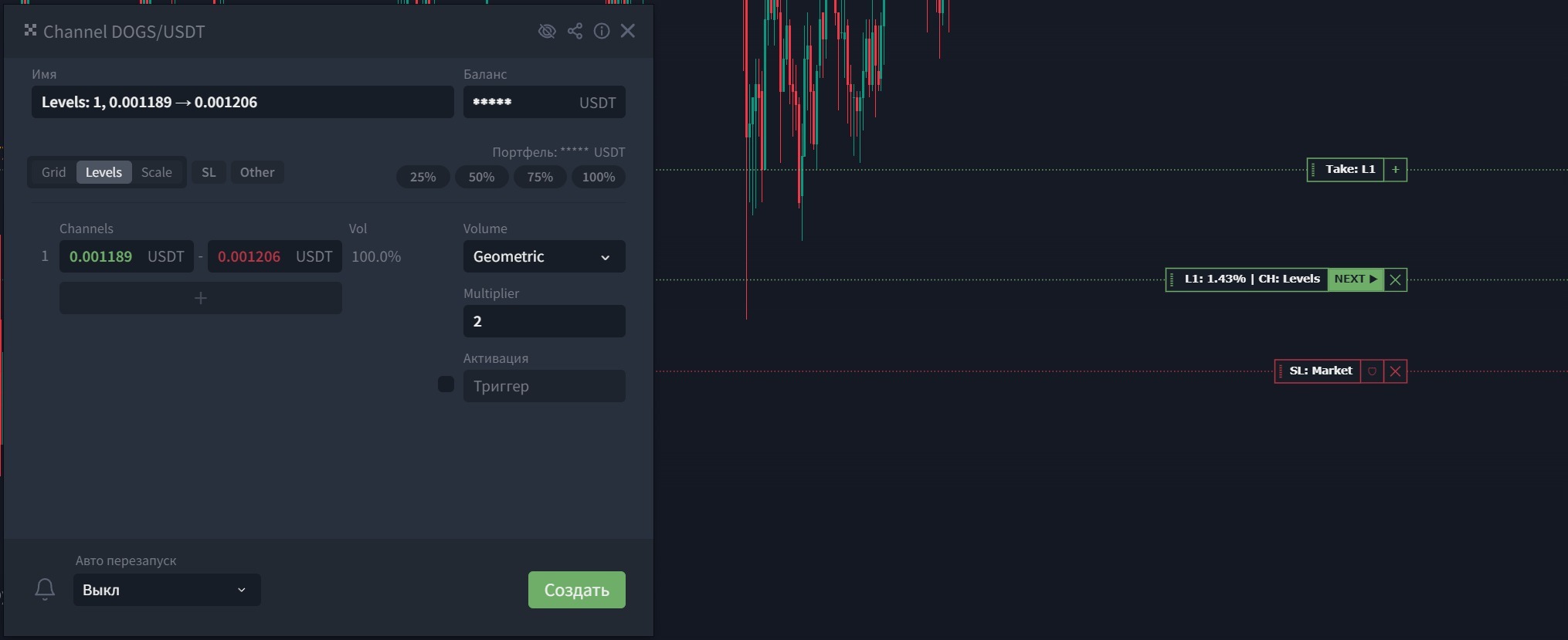
Or you choose a combination of several orders and manually adjust them to levels with equal distribution or with weighting. There is also an option to work with averaging similar to Fibonacci, when the sell level shifts lower. 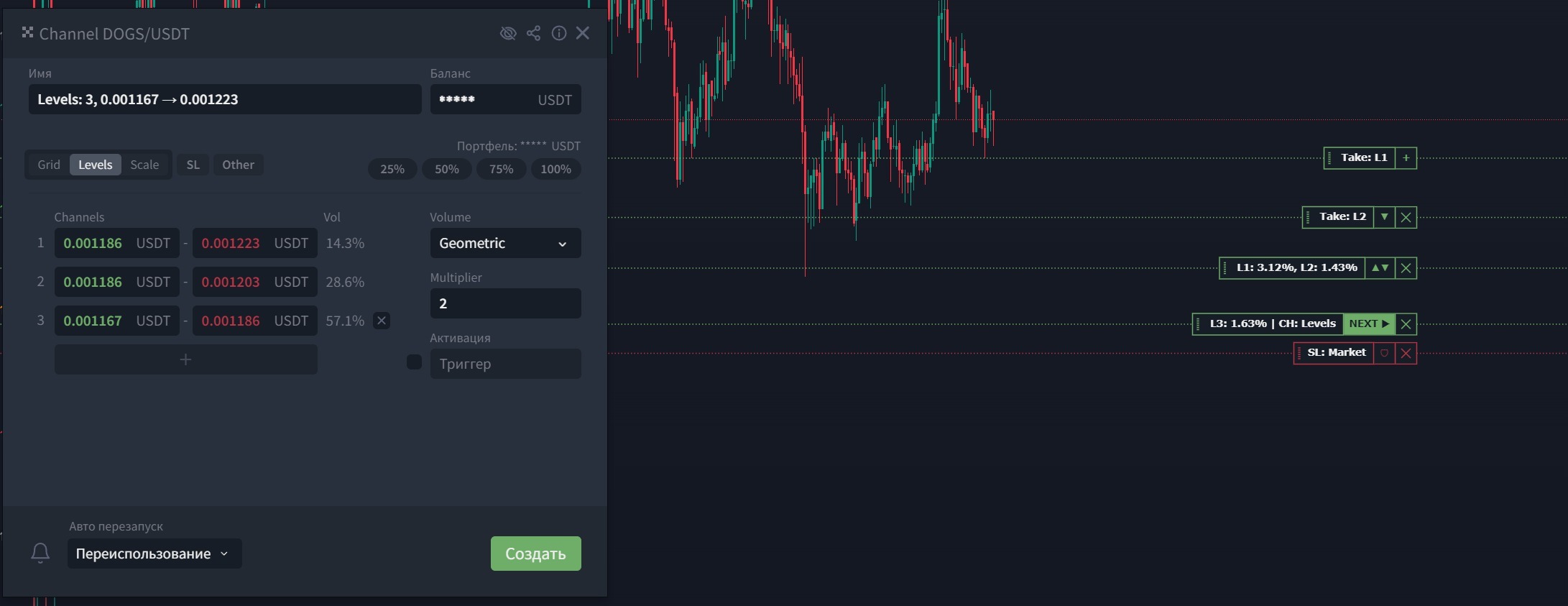
In the Channel strategy settings window, you set the required parameters and also specify the stop.
LEVELS provides flexibility and precision in configuring trading strategies, allowing you to effectively manage positions in various market conditions.
Important:
If you have set a one-time execution scenario, make sure the Auto restart checkbox is disabled.
SCALE
A symbiosis of two systems based on level trading and Fibonacci.
SCALE represents a unique symbiosis that allows you to adapt the strategy to various types of trading tasks.
Key features and use cases of the SCALE system:
Integration of levels and Fibonacci
Work with classic Fibonacci levels as well as custom levels to create individual trading combinations for any market conditions, taking trades once at a level or multiple times.
Averaging levels using Fibonacci
You can configure the strategy to work from any Fibonacci levels, including options for selecting take-profit and averaging levels.
Adaptability and flexibility
SCALE allows you to adapt the strategy to any market conditions and goals, including working with non-standard levels that go beyond the usual Fibonacci levels, for example, one.Beyond boundaries
You can form trading levels above one, expanding the strategy’s capabilities beyond the traditional Fibonacci range.
Example of launching the system:
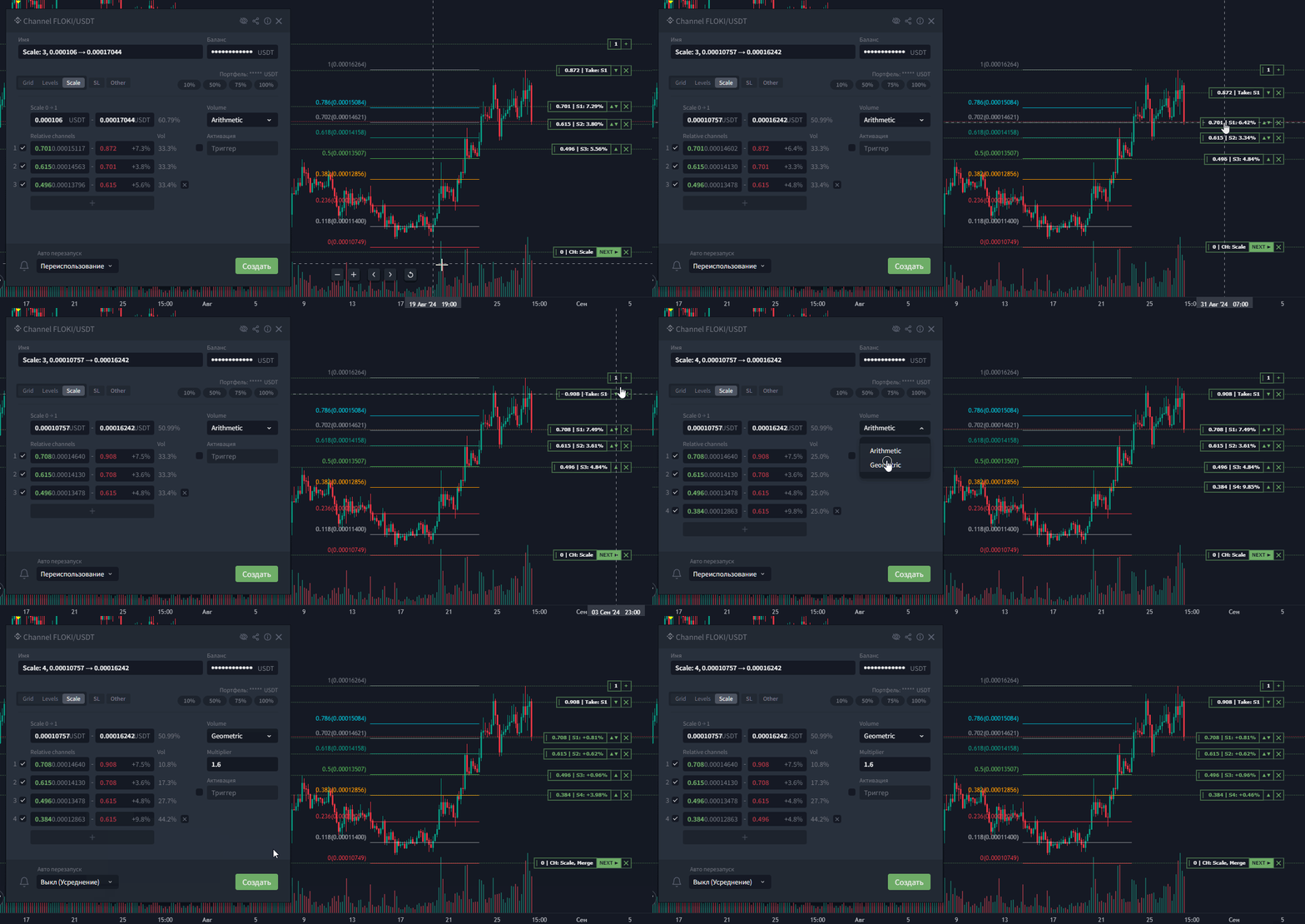
Each of these Channel strategy variations provides unique opportunities for working with assets, offering traders a choice of tools depending on their preferences and goals.
Notes:
If, based on technical analysis, you see potential asset growth, before enabling strategies you can select the accumulation option. Everything earned by the strategies can later be placed for sale at a higher price. Otherwise, accumulated assets do not occupy your trading deposit and remain conditionally free.
When working with market orders, consider the asset’s daily trading volume and the allocated trading funds to avoid pumping the asset when launching the strategy.
Be prepared for positional or long-term trading lasting up to several months. For trading against Bitcoin, BTC purchased at a low price is required.
Was this article helpful?
That’s Great!
Thank you for your feedback
Sorry! We couldn't be helpful
Thank you for your feedback
Feedback sent
We appreciate your effort and will try to fix the article
Ready to try it live?
Everything in this guide works in the LEXX terminal — exchange API connections, trading strategies and automation.
Open the terminal About LEXX Platform